One of the most powerful pictures of life in the womb is found at the beginning of Luke’s Gospel. Before Jesus preached a sermon, healed the sick, raised the dead, or went to the cross, He entered our world in the hidden place of His mother’s womb. The eternal Son of God began His earthly life not in a palace, not in a temple, and not before the eyes of the crowds, but as a child newly conceived in Mary.
Luke 1 tells us that the angel Gabriel came to Mary in Nazareth, a town in Galilee. Mary was a young woman, betrothed to Joseph, when the angel announced that she would conceive and give birth to a son. This child would be called Jesus. He would be great. He would be called the Son of the Most High. His kingdom would never end.
Mary asked how this could happen since she was a virgin. The angel told her that the Holy Spirit would come upon her and that the power of the Most High would overshadow her. The child to be born would be holy, the Son of God.
This is important. The angel did not merely say that Mary would someday become the mother of someone important. He announced that the Son of God would be conceived in her womb. God’s redemptive plan would move forward through conception, pregnancy, and birth. The incarnation did not begin when Jesus was laid in the manger. The eternal Son of God took on human flesh in the womb of Mary.
The angel also told Mary that her relative Elizabeth was already in her sixth month of pregnancy. Elizabeth, who had been unable to have children and was now old, was carrying the child who would become John the Baptist. After hearing the angel’s message, Mary hurried to visit Elizabeth.
Mary lived in Nazareth, in Galilee. Elizabeth most likely lived in the hill country of Judea, near Jerusalem, where her husband Zechariah served as a priest. The journey would have taken several days. Depending on the route, Mary may have traveled more than one hundred kilometers. Luke does not tell us the exact road she took. He does not tell us exactly how many days the journey required. He simply tells us that Mary went with urgency.
This means that when Mary arrived at Elizabeth’s home, her pregnancy was still very early. Scripture does not give us the exact day of Jesus’ conception or the exact day Mary arrived. But Luke’s account strongly indicates that Mary came to Elizabeth soon after the angel’s announcement. Jesus may have been only days or weeks in the womb.
And yet, when Mary greeted Elizabeth, something remarkable happened.
The baby in Elizabeth’s womb leaped. Elizabeth was filled with the Holy Spirit. She cried out in blessing over Mary and over the fruit of Mary’s womb. Then Elizabeth asked why she had been so favored that the mother of her Lord would come to her.
Elizabeth did not speak as though Mary carried only the possibility of the Messiah. She did not speak as though Mary carried a future person who would someday become important. By the power of the Holy Spirit, Elizabeth recognized that Mary was already the mother of her Lord.
At that moment, Jesus was unseen by human eyes. He had not yet developed in the ways that would later be visible. Mary had not yet given birth. She would not have looked pregnant. No crowd had gathered. No shepherds had come. No wise men had brought gifts. And yet heaven already knew who was in the womb.
Jesus was not potentially the Son of God. He was the Son of God.
Jesus was not potentially the Messiah. He was the Messiah.
Jesus was not potentially human. He had already taken on human life.
The child in Mary’s womb was fully God and fully human from the moment of His conception. The perfect image of God entered our world as an embryo. God’s rescue mission was already in motion before Jesus was born.
This should cause us to worship. The Lord of glory humbled Himself to enter the world at the smallest and most hidden stage of human life. He did not despise the womb. He did not bypass human development. He did not appear first as a grown man. He came as we all come, beginning human life in the womb of His mother.
This also teaches us how God views life in the womb. If the Son of God truly became human in the womb, then the womb is not a place of lesser humanity. It is a place where God sees, knows, forms, and values human life.
The world often values human life by appearance, strength, independence, usefulness, or visibility. God does not. Jesus was worthy of honor while He was hidden in the womb. He was worthy of worship before He could be held in Mary’s arms. He was Lord before anyone could see His face.
This does not mean that every child in the womb is divine. Jesus alone is the eternal Son of God. But it does mean that God has shown us something profound about human life. The earliest stage of human development is not outside His care, His knowledge, or His purpose.
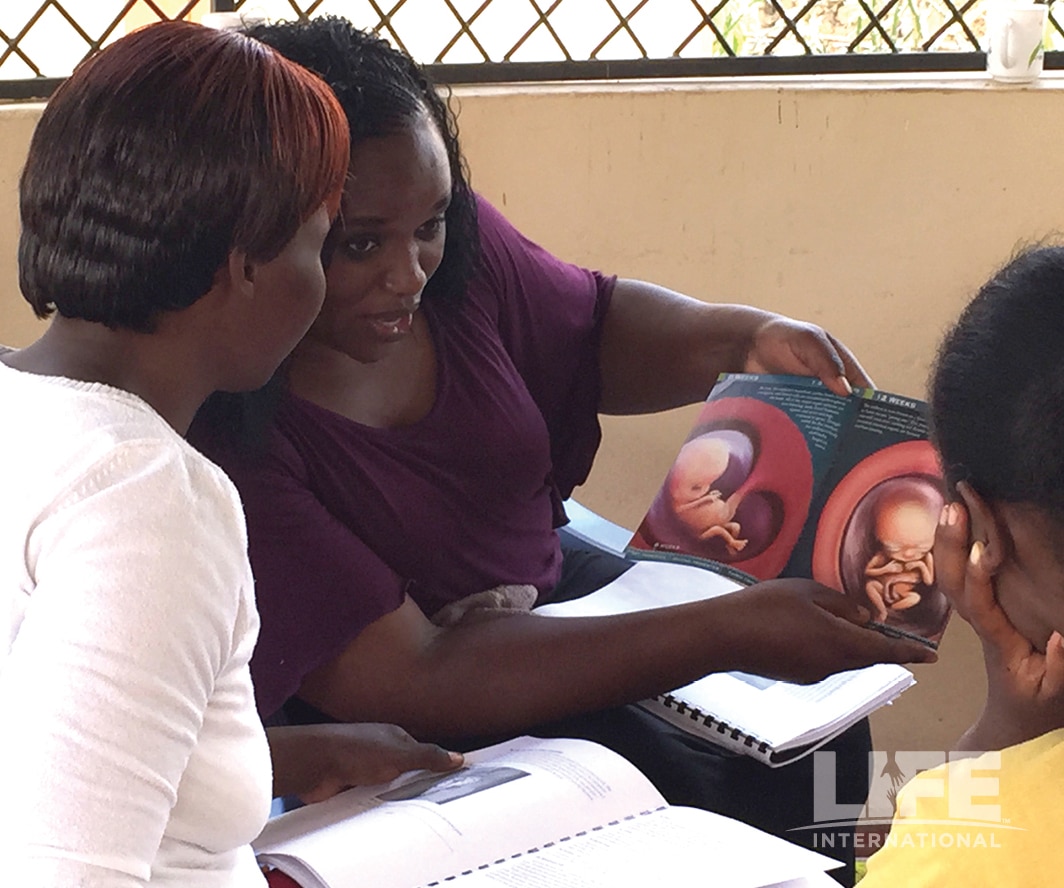
Every human life begins small. Every person who has ever been born was first hidden in the womb. We were not less human because we were small. We were not less valuable because we were unseen. We were not less known to God because the world had not yet met us.
A biblical worldview teaches us to see what the world often ignores. The preborn child is not a potential human being, but a human being with potential. The child in the womb is not valuable because he or she is wanted by others, strong enough to survive independently, or developed enough to be seen. The child is valuable because he or she is created by God and bears the image of God.
Luke 1 gives us an intimate picture. Mary, newly pregnant, comes to Elizabeth. John, still in the womb, responds with joy. Elizabeth, filled with the Holy Spirit, blesses Mary and recognizes the presence of her Lord. Before the birth of Christ, before the manger, before the ministry, before the cross, the Savior was already present among His people in the womb.
If this is how God chose to begin His rescue mission, then we must ask: What does this tell us about the value of life in the womb?
It tells us that hidden life is seen by God.
It tells us that small life is not insignificant life.
It tells us that dependency does not remove dignity.
It tells us that the womb is not a place outside the concern of God.
It tells us that life before birth is life worthy of honor, protection, and love.
As life-givers, we must learn to see the child in the womb through the eyes of God. We must speak with courage and compassion. We must defend the child and care for the mother. We must help families and churches understand that God’s heart for life begins before birth.
The story of Mary and Elizabeth is not only a story about two mothers. It is also a story about two children in the womb. One child leaped for joy. The other child was the Lord of all, already present in the hiddenness of the womb, already fulfilling the promises of God, already moving toward the salvation of the world.